
Fiber Optic Sensing in Road and Bridge Safety Monitoring
Fiber optic vibration sensors utilize the physical mechanism of phase or intensity changes in light transmitted through optical fibers due to external vibrations, enabling non-contact measurement of mechanical vibrations. Their core structure typically employs a Mach-Zehnder, Michelson, or Sagnac interferometer, which demodulates changes in the optical signal to invert vibration frequency, amplitude, and location information. The system boasts high sensitivity, capable of detecting micrometer-level displacements, with a frequency response range covering 0.1 Hz to tens of kHz. In engineering applications, these sensors can be deployed on or inside the surfaces of structures such as pipes, bridges, and tunnels to monitor structural health in real time. Their distributed nature supports long-distance continuous monitoring, and single-point failures do not affect overall operation. Compared to traditional piezoelectric sensors, they offer advantages such as resistance to electromagnetic interference, explosion-proof properties, and corrosion resistance, making them suitable for complex environments such as substations and chemical plants.
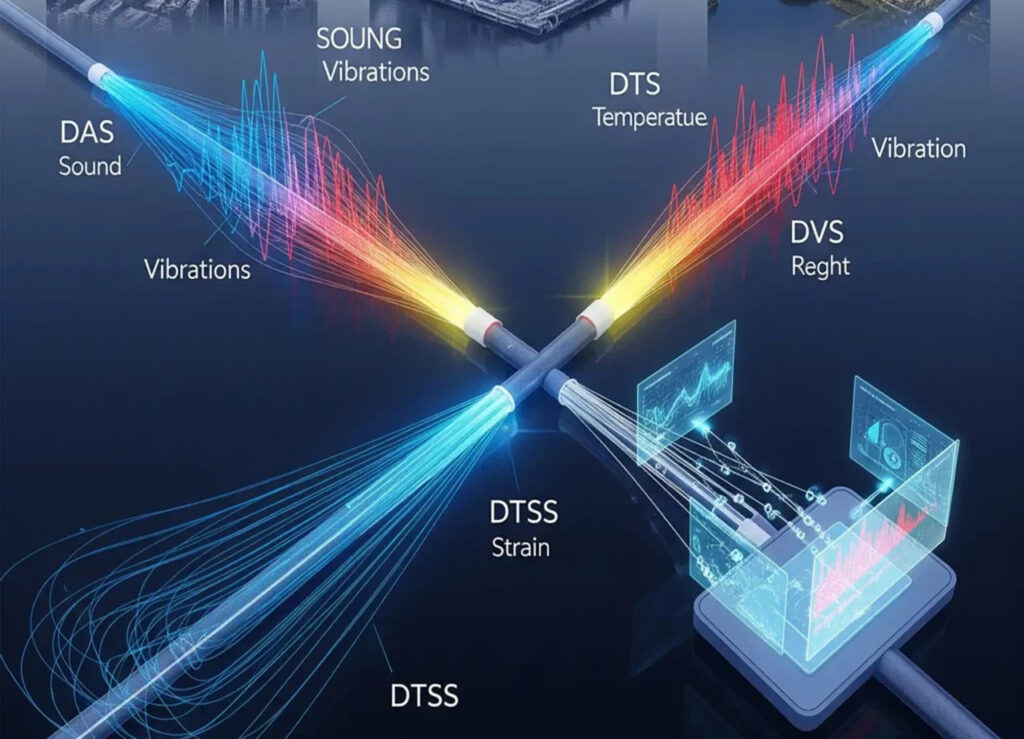
The system uses fiber optic sensors as its core, leveraging the principle that light’s properties change as it propagates through optical fibers due to external physical quantities (such as strain and temperature). A demodulation device converts the optical signal into a quantifiable electrical signal. The sensor network is deployed along key parts of the bridge (such as main beams, towers, and supports), forming a monitoring matrix covering the entire structure. A supporting edge computing module can process basic data locally, reducing the burden on cloud transmission; an encrypted transmission module ensures data security during transmission, preventing tampering or leakage.
1. Functionality and operational logic:
The system utilizes a modular design to expand its functionality: the basic version supports stress, vibration, and temperature monitoring, while the upgraded version can integrate parameters such as displacement and corrosion. During installation, the sensor placement locations must be determined based on the bridge’s structural characteristics, such as denser deployment in stress-concentrated areas like the cable anchorage zone of a cable-stayed bridge and the arch foot of an arch bridge. In daily operation, the system automatically executes a data acquisition, cleaning, and analysis process. When monitored values exceed preset thresholds, an alert is immediately triggered and pushed to the management platform. Administrators can view the data distribution on the bridge’s 3D model through a visualization platform to quickly locate anomalies.
2. Technical advantages and scenario adaptation:
Compared to traditional electrical sensors, fiber optic sensors offer advantages such as resistance to electromagnetic interference, corrosion resistance, and long lifespan (up to 20 years or more), making them particularly suitable for structures like bridges that are constantly exposed to complex environments. Their IP65 protection rating withstands rain and dust, adapting to harsh outdoor conditions. Automatic diagnostics analyzes historical sensor data to identify faults such as zero-point drift and signal attenuation, reducing manual maintenance costs. Encrypted transmission and a visualization platform solve data security and interpretation challenges, enabling even non-professionals to quickly assess the bridge’s health status.
3. Application Cases and Data Value:
In a case study of a cross-river bridge, the system’s monitoring over three consecutive years revealed a consistent increase in deflection in the mid-span region of the main girder during the high-temperature summer months. Combined with temperature-stress curve analysis, this was confirmed to be caused by the thermal expansion and contraction of the concrete, eliminating the need for additional reinforcement. In another case, the system provided a six-month advance warning of abnormal cable tension decay on a cable-stayed bridge. Inspection revealed anchorage corrosion, which was promptly replaced, preventing cable breakage. This data not only provides a basis for current maintenance but can also be used to train machine learning models to predict the bridge’s performance degradation trends over the next 5-10 years.
4. Distributed fiber optic acoustic sensing technology (DAS)
Φ-OTDR technology, first proposed in 1993 by H. F. Taylor et al., uses an ultra-narrow linewidth, high-coherence laser as the light source and detects weak signals through the interference effect of backscattered Rayleigh light.
Since then, Φ-OTDR technology has flourished and is currently one of the most sensitive techniques in distributed fiber optic sensing.
Qualitative Monitoring Stage
This stage primarily utilizes the intrapulse interference pattern of backscattered Rayleigh light to qualitatively characterize vibration information along the fiber optic line, offering irreplaceable advantages in sensing range, event location accuracy, and environmental adaptability.
Quantitative Detection Stage
The quantitative detection stage demodulates the phase information of the Rayleigh scattered light wave and uses the linear relationship between the differential phase and the sound wave to quantitatively reconstruct external vibration information.
Performance Enhancement Stage
This stage mainly optimizes key performance parameters of the system, especially improving bandwidth and spatial resolution performance over long distances, particularly in signal processing and event recognition, thus expanding the application areas of DS technology.
Distributed fiber optic acoustic sensing (DAS) based on phase-sensitive optical time-domain reflectometers is a novel sensing technology that utilizes the backscattering Rayleigh interference effect of optical fibers to achieve continuous distributed detection of acoustic signals.
The structure of distributed fiber optic acoustic sensing mainly consists of three parts: sensing fiber, optical signal demodulation equipment, and signal processing host. The sensing fiber typically uses ordinary single-mode communication fiber (depending on the monitored physical quantity), offering good environmental adaptability and convenient, economical long-term maintenance.
Advantages of ordinary fiber optic sensing technology:
Impact on electromagnetic interference
Good concealment
Environmental tolerance (corrosion resistance, insulation)
Unique advantages of DAS technology:
High information richness (sound waves, vibration, strain, temperature)
Long-distance dynamic monitoring
Distributed real-time quantitative external model reconstruction
5. Highway Case
5.1 In 2016, the North Dakota Department of Transportation (NDDOT) successfully deployed the OptaSense Traffic Monitoring Solution (TMS) on a section of I-29 in Fargo, North Dakota, becoming the first state-level Department of Transportation in the U.S. to deploy distributed fiber optic traffic monitoring and statistics technology.
After a detailed analysis of the technology’s advantages, the NDDOT installed dedicated fiber optic cables to monitor both sides of I-29 and selected ramps along a 4.5-mile test stretch. This initial project has been successfully completed, and the NDDOT has submitted its findings and future technology plans to the National Transportation Innovation Council (STIC).
[Image: Monitoring Project]
The OptaSense traffic monitoring solution enables the following monitoring objectives:
Average speed;
Travel time;
Automatic congestion detection;
Automatic queue detection.
5.2 A distributed fiber optic traffic monitoring application funded by the Georgia Department of Transportation. The Atlanta area has some of the highest highway traffic volumes in the United States. According to the 2019 Urban Traffic Report, Atlanta drivers spent an average of 77 hours per year commuting, ranking sixth in traffic congestion nationwide.
In the first quarter of 2020, GDoT successfully deployed its OptaSense traffic monitoring solution on a section of Interstate 20 in Atlanta. This project validated the practical performance of OptaSense’s distributed fiber optic acoustic sensor-based traffic monitoring solution and determined that it can provide accurate and up-to-date traffic speed and traffic count information.
Future plans include integrating the data collected by the OptaSense traffic monitoring solution into its existing traffic management center system platform.