
Digital Twin Technology for Roads and Bridges: From Monitoring to Predictive Maintenance
Digital twin technology is profoundly transforming the entire lifecycle management of road and bridge engineering by constructing virtual models that map and interact with physical entities in real time. Its core value lies in moving from real-time monitoring to predictive maintenance, enabling intelligent management and control of infrastructure.
Digital twins are a comprehensive application system integrating multiple cutting-edge technologies such as the Internet of Things, big data, artificial intelligence, and 3D visualization. Its core lies in creating a dynamically updated “digital twin” of a physical road or bridge. Through a widely deployed sensor network (such as strain gauges, accelerometers, cameras, and weather stations), real-time data from multiple sources, including traffic flow, structural stress, vibration, cracks, and environmental temperature and humidity, is collected. This data is then fused and processed using cloud computing and edge computing, ultimately enabling a visual platform that provides an intuitive presentation and in-depth analysis of the infrastructure’s status.
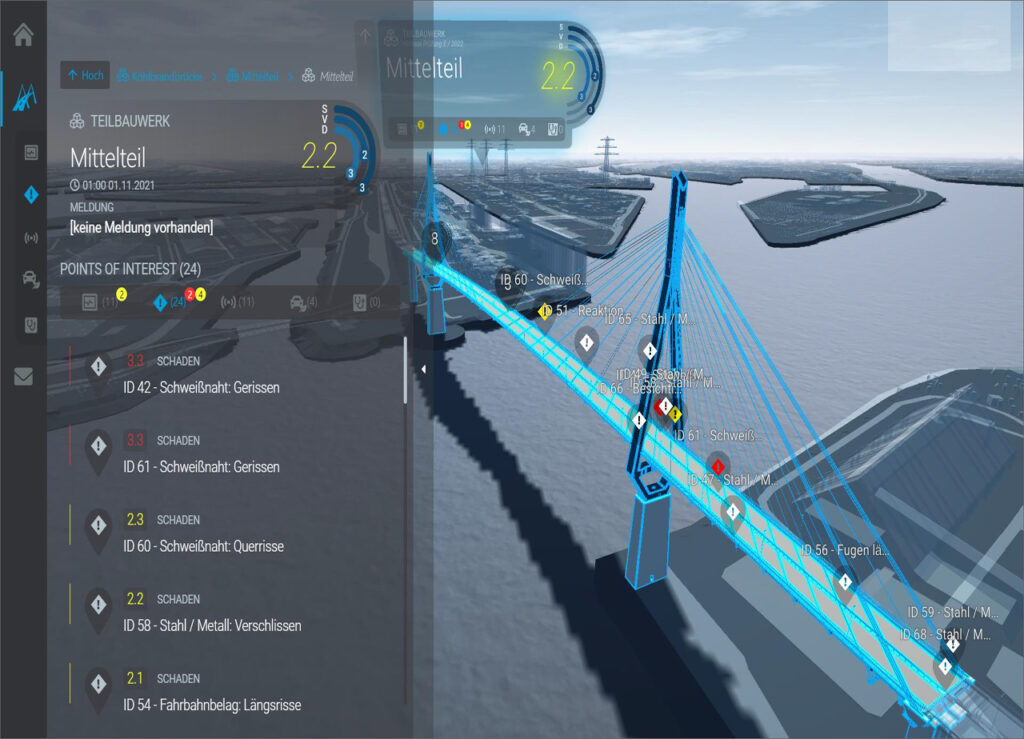
The application of technology permeates all stages of infrastructure design, construction, operation, and maintenance:
**Design and Construction Stage:** During the design phase, digital twin models can be used for structural simulation and optimization, validating design schemes. During construction, by integrating construction progress, material, and equipment data into the model, digital monitoring and management of the construction process can be achieved, ensuring project quality and schedule.
**Operation and Monitoring Stage:** This is the core of technology application. Digital twin systems can monitor and assess the structural health of bridges and roads in real time, promptly identifying anomalies and ensuring operational safety. For example, continuous monitoring of key bridge components (such as piers and beams) effectively identifies potential structural damage risks.
**Maintenance and Management Stage:** The highest value of technology application lies in the shift from “reactive maintenance” to “predictive maintenance.” Through in-depth analysis of historical and real-time data, models can predict trends such as material aging and fatigue damage, providing early warnings of potential defects, thereby planning optimal maintenance timing and solutions. This not only extends the service life of facilities but also significantly reduces maintenance costs and traffic disruptions caused by construction.
1. Management dilemma of roads and brideges
In real-world projects, bridge maintenance often faces three major challenges. First, data is fragmented. There are numerous systems—structural monitoring, traffic flow, environmental data, video surveillance—but they operate independently, failing to create a cohesive picture. Data exists, but a holistic perspective is lacking. Second, the status is visible but incomprehensible. Even with monitoring data, most simply set thresholds—exceeding them triggers an alarm; otherwise, everything is considered normal. However, bridge safety is never simply a matter of “whether there’s a problem,” but rather how the problem is evolving. Third, management is reactive. Traditional models almost always involve investigating and addressing issues only after an anomaly occurs. But truly high-level infrastructure requires proactive risk prediction, not reactive risk response.
2. Road & Bridge Technology's Solution: Digital Twin Technology
Digital twin technology is far more than simply building a 3D model of a bridge; it constructs a virtual system that can synchronize with the real bridge in real time, is computationally comprehensible, and capable of extrapolation. By integrating various multi-source data, it enables a qualitative leap in bridge management. With digital twins, we can transform from “two-dimensional data” to “three-dimensional perception”: every beam, every support, every sensor, and real-time traffic status of the bridge is reconstructed in three dimensions to form a visualized scene. Managers no longer see dry reports, but rather the most realistic real-time state of the bridge. Simultaneously, it upgrades from “static display” to “dynamic perception,” capturing in real-time stress changes, vibration response, temperature effects, and traffic load distribution, allowing the once silent bridge to “speak,” with every subtle change accurately captured. More importantly, it drives management from “post-event analysis” to “predictive decision-making.” Through simulation and algorithmic analysis, it can predict crack propagation trends, assess structural fatigue life, simulate the impact of extreme weather, and extrapolate overload impact risks, upgrading management decisions from “experience-based judgment” to “model-supported” decision-making.
3. Decision-making hub: Large-screen full-domain management
In digital twin systems, many people mistakenly believe that large screens are merely display tools, good-looking but in reality, they are essentially “real-time operating systems” for bridge management. A truly valuable digital twin screen should possess at least four layers of capabilities. The first layer is comprehensive situational awareness: overall bridge health status scoring, multi-bridge joint monitoring, and risk distribution heatmaps—upgrading from managing a single bridge to managing a group of bridges. The second layer is structural-level fine-grained monitoring: component-level stress and displacement visualization, real-time early warning of key nodes, and structural health trend curves—precision extends from the “entire bridge” to “each individual component.” The third layer is risk warning and tiered response: multi-level early warning mechanisms (prompts, warnings, alerts), automatically linking the scope of impact and providing emergency response suggestions—upgrading from simple “alarms” to “decision support.” The fourth layer is closed-loop operation and maintenance management: digitization of inspection tasks, correlation of maintenance records with the model, and traceability of historical issues—truly achieving a complete closed loop of monitoring, analysis, processing, and review.
4. It's not just about efficiency, but also an upgrade of the "safety paradigm".
Digital twin technology brings not only improved efficiency to bridge management, but also a fundamental upgrade to the safety paradigm. This change is reflected in three core aspects: from “human monitoring of bridges” to “bridge self-reporting,” the system can proactively identify anomalies, no longer relying on accidental human discovery; from “experience-driven” to “data-driven,” freeing bridges from dependence on individual experience and ensuring that every decision is supported by models and data; and from “passive maintenance” to “predictive maintenance,” proactively intervening in potential risks to prevent accidents and completely abandoning the passive situation of “post-accident repair.”
5. The "basic capabilities" of urban infrastructure management
Today, bridge digitization is no longer just an added bonus, but a fundamental capability for urban infrastructure management. The driving forces behind this are clear: urban infrastructure is aging rapidly, extreme weather is becoming more frequent, traffic loads are continuously increasing, and safety regulations are constantly rising. If we remain in the traditional model, risks will only accumulate day by day. A bridge is not just a pile of reinforced concrete; it is a “computable asset.” We believe that the bridge of the future should be a perceptible, analyzable, predictable, and decision-making intelligent entity. And digital twins are the key technology that makes all of this a reality!