
Dynamic Weigh‑In‑Motion (WIM): The Key to Modern Overload Enforcement
Overloading remains a persistent problem in China’s road transport, posing a significant hidden danger. It not only increases the risk of traffic accidents and infrastructure damage but also undermines the fair competition between overloaded and non-overloaded trucks. Therefore, ensuring that trucks comply with weight regulations is crucial. In recent years, Dynamic Weighing (WIM) technology has emerged, providing a new solution for overloading supervision and enforcement. This technology can weigh trucks while they are in normal operation without interfering with their driving, thus helping to improve the safety and efficiency of truck operation.
1. Potential risks of overloaded trucks:
Overloaded trucks are more likely to be involved in accidents and have more severe consequences than legally loaded trucks. The greater the vehicle’s weight, the greater its kinetic energy, resulting in greater impact and damage to other vehicles and infrastructure in a collision. It’s important to note that not all heavy cargo is problematic; the key is whether the cargo matches the truck’s carrying capacity. However, when a truck’s load exceeds its maximum permissible weight, it can lead to several adverse effects:
Decreased Truck Stability: Overloading raises the truck’s center of gravity and increases inertia, reducing vehicle stability. Furthermore, onboard stability systems (such as ESP and rollover prevention systems) may become ineffective due to excessive load, increasing the risk of rollovers and lane departures. Overloading also causes tire overheating, increasing the likelihood of tire blowouts. When transporting flammable goods, overloading further increases the risk and severity of fires in the event of an accident or loss of truck control.
2. Static weighing: a traditional regulatory and enforcement method
Prior to the mid-1990s, static weighing was the only legally recognized method in metrology. This method primarily relied on weighbridges and axle scales to measure the total weight of a vehicle and the load on its wheels or axles. With axle scales, the total weight was calculated by adding the loads on each axle; with wheel scales, the axle load was calculated by summing the wheel loads on the same axle.
Static weighing devices can be categorized into three types: fixed systems, semi-fixed systems, and portable systems. Fixed systems are typically permanently installed on the road surface, such as on a concrete frame or platform; semi-fixed systems combine permanent recesses with road infrastructure, but portable scales are only installed during weighing operations; portable systems involve laying wheel or axle scales on the road surface, supplemented by leveling plates or ramps to ensure all weighed wheels are on the same level.
However, static weighing faces numerous challenges. It requires personnel to select and intercept trucks in busy traffic flow, guide them to a static control area for weighing, and enforce penalties such as fines as needed. On highways and expressways, due to the large volume of truck traffic, static weighing is often difficult to ensure safety and is inefficient, often only having a limited deterrent effect.
3. Emerging regulatory and enforcement method: dynamic weighing
To address the numerous shortcomings of static weighing, dynamic weighing technology has emerged, aiming to improve weighing efficiency through partial automation. In China, many regions have already implemented low-speed dynamic weighing systems. This technology primarily relies on wheel scales or axle scales, equipped with high-precision load cells. These sensors are mounted on concrete or asphalt platforms up to 30 to 40 meters long. Software in the data acquisition and processing system analyzes the signals transmitted by the sensors to accurately calculate the load on the wheels or axles. The system achieves an accuracy of 3-5%, and trucks do not need to stop; they only need to slow down to a speed of 5-15 km/h within the weighing area to pass through.
Low-Speed Dynamic Weighing (LS-WIM) System vs. High-Speed Dynamic Weighing (HI-WIM) System
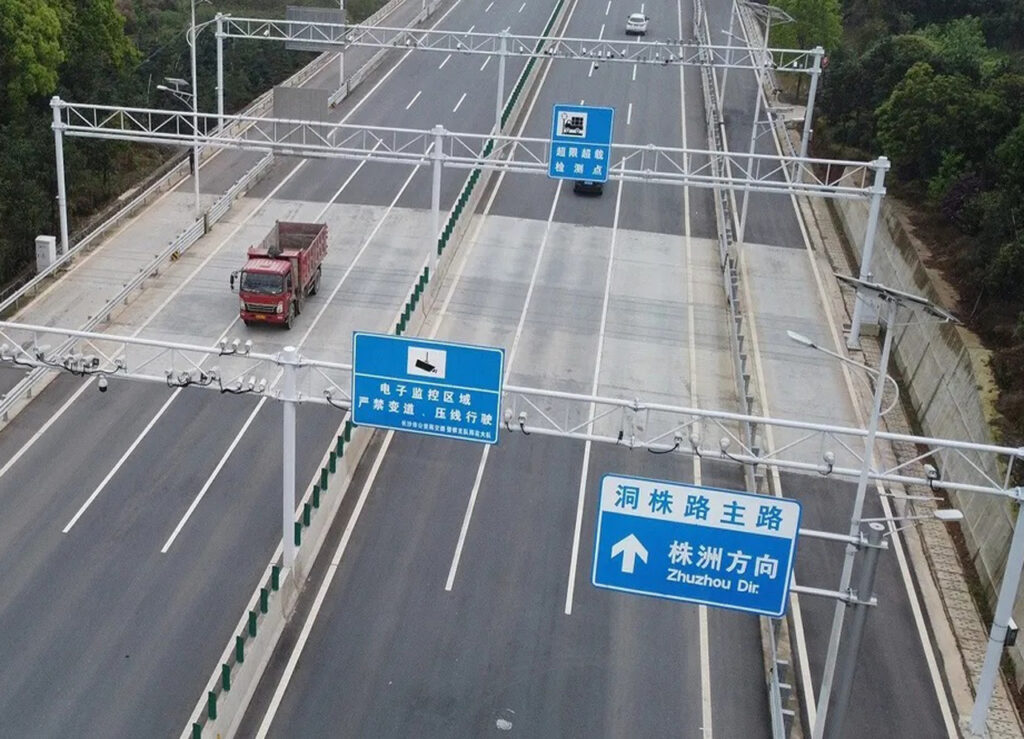
Low-speed dynamic weighing systems are primarily suitable for weighing trucks at low speeds, as seen in many areas of China. High-speed dynamic weighing, on the other hand, involves sensors installed on the roadway to measure the axle load and vehicle load of trucks traveling normally. This system can weigh almost all trucks passing through road sections and record detailed individual measurements or statistical data.
High-Speed Dynamic Weighing System
The High-Speed Dynamic Weighing (HI-WIM) system offers the following significant advantages:
Fully Automated Weighing: This system automatically records detailed information about passing vehicles, such as speed, number of axles, and transit time.
Infrastructure Utilization: It can be integrated with existing infrastructure, similar to the use of electronic surveillance cameras, requiring no additional infrastructure investment and thus reducing costs.
Multi-functional Applications: The HI-WIM system can not only record the load conditions of road and bridge engineering projects in real time, but also be used for traffic data collection, freight statistics, economic surveys, and even provide a basis for road toll pricing. Furthermore, it can pre-screen overloaded trucks before they enter the inspection area of static or low-speed dynamic weighing systems, improving inspection efficiency.
4. Panel-type sensor dynamic weighing system
Panel-mounted sensor dynamic weighing systems, as a unique weighing technology, possess distinctive applications and advantages. This system utilizes sophisticated sensor technology to monitor and record vehicle dynamic weighing data in real time, including vehicle speed and axle load. Its advantages include simple installation, minimal impact on road surfaces, and adaptability to various road conditions. Furthermore, the system can be integrated with traffic management systems, providing strong support for traffic management and safety. However, this system also faces challenges, such as the stability and accuracy of sensor performance, requiring continuous technological optimization and upgrades.
5. Single-strip sensor dynamic weighing system
Single-strip sensor dynamic weighing systems are gaining attention as a simple and efficient weighing solution. This system uses a single-strip sensor design to directly measure dynamic vehicle weighing data, including key information such as vehicle speed and axle load. Its advantages include simple structure, convenient installation, and accurate and rapid data delivery. However, compared to panel-type sensor dynamic weighing systems, single-strip sensors may have limitations in adapting to complex road conditions, requiring further technological improvements to meet the needs of different application scenarios.
6. Multi-strip sensor dynamic weighing system
Multi-strip sensor dynamic weighing systems offer greater road adaptability compared to single-strip sensor systems. By employing a multi-strip sensor design, this system can measure vehicle dynamic weighing data more comprehensively, including vehicle speed, axle load, and other detailed information. Its advantage lies in its ability to adapt to more complex road conditions and provide more accurate and comprehensive weighing data. However, compared to panel-type sensor dynamic weighing systems, multi-strip sensor systems may present certain challenges in installation and maintenance, requiring corresponding technical support and operation by qualified personnel.
Development Trends: High Precision, High Reliability, and Rapid Deployment
Currently, dynamic weighing technology is developing towards higher precision, stronger environmental adaptability, faster deployment, and stronger anti-interference and anti-cheating capabilities. Modular design allows the system to be installed and reopened to traffic within 24 hours, and domestically produced equipment continues to make breakthroughs in precision and reliability.
Driven by policy and market demand, non-site enforcement systems centered on dynamic weighing are developing rapidly, and the market size is expected to continue to expand, becoming an important component of intelligent transportation and modern governance systems.