
Smart Bridge Structural Health Monitoring (SHM): Technologies, Applications, and Future Trends
Das Structural Health Monitoring (SHM) gleicht im Wesentlichen einer „medizinischen Untersuchung“ von Brücken und Tunneln. Es nutzt diverse Sensoren – wie etwa Dehnungsmessstreifen, Beschleunigungssensoren sowie Temperatur- und Feuchtigkeitssensoren –, um in Echtzeit Betriebsdaten über das Bauwerk zu erfassen; dazu zählen Faktoren wie Schwingungen, Verformungen und die Rissfortschrittsrate. Diese Daten werden an ein Backend-System übermittelt, wo Ingenieure sie analysieren, um etwaige strukturelle Anomalien zu erkennen und rechtzeitig Warnungen vor potenziellen Problemen auszusprechen.
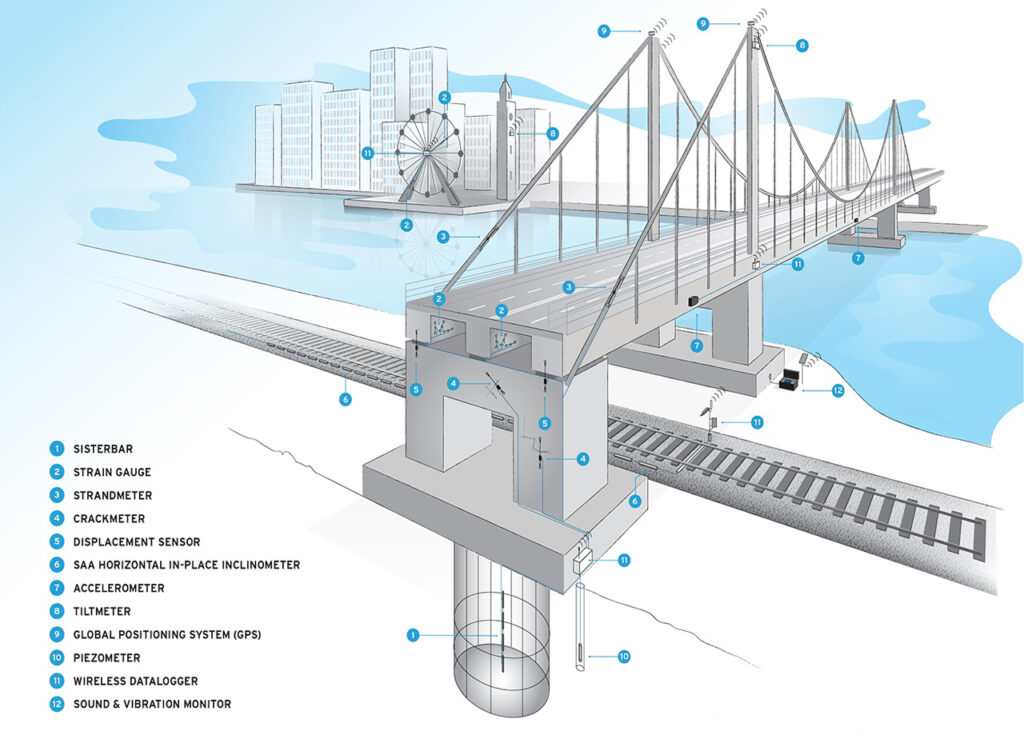
Let’s look at several real-world examples to compare the effectiveness of structural health monitoring.
Successful Case: The Shanghai Nanpu Bridge upgraded its SHM (Structural Health Monitoring) system in 2019, adopting wireless sensors and an AI data analysis platform. Through deep learning algorithms, the system automatically identified abnormal vibration patterns and detected abnormal stress in the main cables three months in advance. Ultimately, reinforcement was completed before the accident, preventing losses of hundreds of millions of yuan.
Failure Case: A provincial highway bridge installed a large number of sensors in 2017, but the backend only performed simple data statistics, lacking intelligent analysis. As a result, monitoring data piled up, and real anomalies were buried until cracks appeared in the bridge deck, missing the best intervention opportunity.
Data statistics show that the accuracy rate of AI-powered structural health monitoring and early warning can be improved to over 85%, while traditional SHM hovers around 60%. This is inseparable from the support of data intelligence platforms and algorithms.
1. Industry pain points and improvement directions
Incomplete data collection and unreasonable sensor installation point layout lead to monitoring “blind spots” in key areas.
Insufficient data analysis capabilities result in low efficiency of manual screening, leading to frequent missed or false alarms.
Severe information silos prevent monitoring data from being integrated with operation and maintenance management systems to form a closed loop.
High operation and maintenance costs are compounded by a lack of standardized procedures for system upgrades and maintenance.
To address these pain points, the industry is advancing:
Intelligent data collection and edge computing to improve data real-time performance and effectiveness;
AI algorithms to automatically identify anomalies, reducing reliance on manual intervention;
Integrated data platform operation and maintenance management to achieve automated closed-loop response.
2. Technical Challenges and Industry Challenges in Implementing AI
While AI is powerful, several pitfalls remain in practical applications.
Data quality and labeling issues: AI models require large amounts of high-quality, accurately labeled data. In actual engineering projects, complex data collection environments and inconsistent labeling lead to model misjudgments.
Algorithm generalization ability: Bridge and tunnel structures are diverse, and different projects have significant differences in characteristics. AI models cannot be universally applicable and require customized development.
Real-time performance and edge computing: Traditional AI analysis requires powerful computing capabilities and is deployed on remote servers. Limited network conditions at bridge and tunnel sites cause data transmission delays that affect real-time performance.
Difficulty in integrating with traditional operation and maintenance processes: Operation and maintenance teams are accustomed to human experience, making it difficult to adopt AI suggestions, thus hindering the technology’s implementation.
3. Future Trends of Structural Health Monitoring and AI Empowerment
Looking ahead, bridge and tunnel structural health monitoring will exhibit the following development trends:
Full lifecycle monitoring: Tracking structural health data throughout the entire process from design, construction, operation to decommissioning.
Popularization of digital twins: Real-time reconstruction of structural status based on AI and simulation technologies, achieving virtual-real synchronization.
Intelligent early warning and autonomous maintenance: AI automatically analyzes anomalies, and collaborative robots complete structural repairs, achieving unmanned operation.
Cross-industry data sharing: Integrating data from transportation, energy, municipal, and other fields to achieve city-level safety collaboration.
Taking a European city as an example, its city-level bridge and tunnel safety platform has achieved simultaneous monitoring of 50 bridges and 30 kilometers of tunnels, reducing the accident rate by 80%, becoming a model for smart city construction.
4. Summary and Value Reinforcement
Looking back, is structural health monitoring truly effective? The answer is yes, but only if technology, data, and management are coordinated. AI-powered bridge and tunnel safety has become a new industry trend, but its implementation still faces challenges such as data quality, model customization, and talent development. Intelligent solutions (such as OTTAI-ITS) have become the “central hub” of structural health monitoring, connecting all aspects of data collection, analysis, operation, and management, thus ensuring bridge and tunnel safety.